
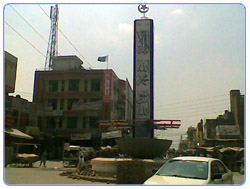
Khanewal is district in the province of Punjab, Pakistan.
It most widely known for being the host city to the second largest Train
Station in Pakistan. The largest Train Station in Lahore, which is the
capital of Punjab. It is also the home town of two Pakistan's national
cricket team's players: Shabbir Ahmed and Iftikhar Anjum, Well known great
cricketer Amir Gujjar also belongs to khanewal.
According to the 1998 census of Pakistan, the district had a population of
2,068,490 of which
17.42% were urban
Search Khanewal on Satellite
Map
Places of Interest
| Hotels |
Eating &
Dining | Parks &
Gardens |
Educational Institutes |
Hospitals |
Sport Centers |
Banks |
ATM |
Fuel Stations |
CNG Stations |
Police Stations |
Shopping /Trade
History
The district of Khanewal was created in 1985 out of the two tehsils of
Multan District, namely Kabirwala and Mian Channu. Its boundaries meet the
districts of Jhang and Toba Tek Singh on the North, Sahiwal on the East,
Vehari District on South and with Multan on the West.
Historically Khanewal is an old city having its earliest foundations laid by
the British Empire owing to its importance as a railway junction. The city
was a junction of the Wazirabad -Khanewal railway line and provided a
connection to the city of Karachi via Multan. Its straight roads show that
it is a well planned town by the British people. The earliest settlers are
said to be the Dahas like Khan Haibat Khan Daha,and Khatters like sardar
Iftikhar Ahmed Khan Khatter who have the 'Khan' in their names and the city
was named after them as Khan-e-wal. Khanewal was declared district in 1985.
Find more about History of Pakistan
Geography
Underground water resources are generally adequate throughout the district.
The subsoil water is sweet throughout the district and suitable for
industrial purposes. There is no mentionable nullah available in the
district. However, effluent of industry can be disposed of in the
rivers,namely Chenab and Ravi,after pretreatment, with permission from
Irrigation and Power Department, Government of the Punjab. There are 26
telephone exchanges operating in the district (ranging in capacity from 200
lines to 7200 lines). Cellular phone services are also available in the
district. 20 National Bank Branches, 24 Post Offices, Toatal Area 1058641
Acres, 7 Textile Mills, 1 Sugar Mill, 71 Cotton ginnign Factories, 17 Police
Stations,
Language
About 63% of population of district speak Punjabi language. Saraiki is the
second most widely spoken language by 26% of population.Others languages
spoken are urdu,pushto & hindko.
Tribes & Clans
The district is home to a variety of clans, the principal ones being the
Kamboh, Arian, jatt, Hiraj, jat, Niazi, Utra, Gujar, pathan, Chadhrar,Rajput,
Sahu,and Rehmani, Khiarah
Infrastructure
The district has a total metalled road-length of 1208 kilometres. The
district is linked with Multan, Lodhran, Sahiwal, Vehari, Toba Tak Singh,
and Jhang districts through metalled roads.The main Peshawar-Karachi railway
line passes through Khanewal district. The district is linked with Multan,
Lodhran, Sahiwal and Jhang districts through railway network.
Industry and Agriculture
Khanewal is an agricultural city and is located in Pakistan's 'Cotton belt'
- an area covering Khanewal, Multan and Bahawalnagar. It is known to produce
the finest cotton in the World. However over the last 40 to 50 years
industry has also been established in and around the city. Sir
William Roberts established cotton trading and ginning installations in the
area known as Brooke Bond which is now called Unilever, a company that
specialises in making tea. There are over 900 workers employed by Unilever.
The people of Khanewal are hard working and mostly committed to agricultural
activities which is the main source of income for the people of the
district. Other industries in Khanewal include chemical production and oil
extraction. This has added to Khanewal's economy, growth and prosperity
Landmarks
One of the most famous landmarks in Khanewal is the Jangle Wali Kothi, the
foundation stone of which was laid in 1913 by a Railway Engineer posted to
Khanewal Railway Junction during the colonial period.Another place which is
regarded as the oldest in suburbs of Khanewal is Kothi of Amir Baksh Khan
Bhutta. The Khanewal junction is also a landmark as some parts of it have
remained unchanged for over 130 years. Khanewal also has some other colonial
landmarks dating back from the early 20th century, all private properties,
but truly historic. A few of these properties were built and used by Sir
William Roberts who is considered along with several others as one of the
founding fathers of Khanewal and the famous farms outside Khanewal.
Notable Cricket Players
from Khanewal
Masood Anwar is a former Pakistani cricketer who played in one Test in
1990.he is still serving cricket in karachi for ubl. he has got a brother
called awais anwar also playing first class cricket.faboulous talented
familyRana Shabbir Ahmad is a line-and-length pace bowler who took eight
wickets for 109 runs on his Test debut against Bangladesh. Rao Iftikhar
Anjum was selected for the Pakistani squad to play in the 2007 Cricket World
Cup.
Businesses in this city
More on Yellow Pages- A ONE RADY MADE GARMENTS — Khanewal
- ABDULLAH TEXTILE MILLS (PRIVATE) LIMITED — Khanewal
- Aziz Cadit School — Khanewal
- CHAUDHRY MUHAMMAD YAR CORPORATION — Khanewal
- IBL INTERNATIONAL BRANDS (PRIVATE) LIMITED — Khanewal
- NISHTAR MEDICAL HALL — Khanewal
- NOOR SONS — Khanewal
- OCS PAKISTAN (PRIVATE) LIMITED — Khanewal
- OPPO Experience Store Khanewal — Khanewal
- ROBERTS COTTON ASSOCIATES LIMITED — Khanewal